
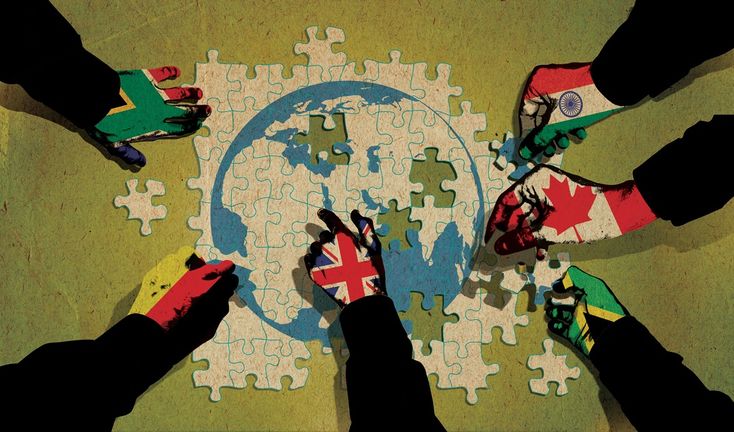

Over time, we might see a more separated world as more and more countries aim to be self-reliant to best serve themselves, even amid complex global situations. Moreover, these international efforts reduce countries’ connectivity and seem to point toward a path that eliminates globalisation.
The end of globalisation would likely result in the near-complete independence of almost every nation. When all the countries are so independent, they do not need the resources, the producers, or the consumers of any nation. Hence, the nation would be completely self-reliant, and no conflict outside the country would affect it. Hence, economies would function almost on their own. This reduces the need for global cooperation and communication needed to combat central issues and threats like climate change.
Reducing global dependence of some nations on others may not necessitate the complete shutdown of globalisation. When a nation is deprived of the ability to benefit from the resources and trade of another nation due to their stances, it can always opt for other nations to partner with. Let’s take US-China relations as a concrete example. USA and China are both major powers in global connectivity and trade-facilitating fields such as technology and mass production. However, due to recent clashes between the two sides, a gap has been clearly detected between them. Despite such circumstances, global trade or, for the matter, trade between the US and China, didn’t stop. US and China both opted for different outlooks but also continued trade to some extent. This doesn’t directly break the world into two groups. Rather, it transformed trade routes but continued the same journey. This implies that globalisation may not end due to nations cutting off relationships. Other nations may also face similar circumstances, potentially leading to the same or similar results.
This suggests that what seems to be the decline of globalisation might rather be a transition to a different form of globalisation, more fragmented, which would be moulded to fit current standards. It is well known and documented that not all resources are available to every nation. This implies the inevitable need to import and export goods. Various alliances would likely appear similar to the already present BRICS and NATO, as these alliances would allow more independence for the country and limit excess foreign exchange. Globally, this results in the formation of small regionalities that function like a globalised unit but on a smaller scale. As a group, they function similarly to an interdependent body, from processing to production.
Fragmentation of global cooperation will lead to greater disruptions in global peace and functionality as a global unit. Global fragmentation creates a divided world, making issues like global warming and climate change exponentially more dangerous. Climate change requires the collective understanding and commitment of nations, as emissions released in one country affect the entire world. However, fragmented nations may prioritise their own economic interests over collective environmental goals, delaying emission reductions and restricting the sharing of renewable technologies and resources. Developing nations, often lacking the means to combat extreme weather and rising sea levels, may be left without adequate support. Unclear communication and weakened cooperation would limit the world’s problem-solving capabilities. This slows essential climate action and potentially leaves millions vulnerable to consequences that could have been prevented.
Greater self-reliance can turn countries into more resilient bodies in order to act towards disruptions by geopolitical conflicts. A nation that depends heavily on other nations can face severe problems during trade disruptions. The vulnerability of global supply chains demonstrates this connection: a 2026 IMF working paper found that a 100-hour increase in shipping delays was associated with roughly a 0.5-percentage-point increase in inflation at its five-month peak. Rather than eliminating international dependence, countries may therefore seek to reduce their exposure to individual sources and diversify their suppliers. International trade can therefore be utilised by countries while limiting the consequences of disruption of trade.
A fragmented globe may improve self-sufficiency but proves to be counter-productive. These small groups make every member nation dependent on the whole group, and the inability of a single nation to do its part can cause instability elsewhere in the group. This may cause disputes within the group, which may break down the group even further. This actively demonstrates that regionalisation does not eliminate interdependence; it merely concentrates it within smaller groups, creating new forms of vulnerability.
Countries are well aware of the problems with relying merely on a single source. Hence, they diversify sources they can’t rely on themselves. By doing so, they tend to be safer from instability. When one source fails, they can opt for a different source completely, while maintaining their regionalities. This methodology even works in the situation we see today and acts as a fail-safe system for particular scenarios. Currently, due to the recent US-Iran conflicts, we have seen a breakdown of the Middle East’s oil supply, which has led to oil shortages in different regions globally. Countries with multiple sources of oil and petroleum were able to handle this situation with much ease compared to elsewhere, despite the Middle East’s oil comprising 31.2% of global energy supply, as pointed out by VisualCapitalist.
In conclusion, we can agree that globalisation isn’t really breaking apart but instead changing form. The WTO’s (World Trade Organisation) 2026 analysis found that although fragmentation pressures increased, nearly three-quarters of world merchandise trade still crossed borders under MFN terms by early 2026. It also found that US imports from China fell 29% in 2025, while Chinese exports were redirected toward other regions. The world is constantly changing and evolving, and so are its regimes.
Globalisation is another philosophy that is set to develop into a more suitable and applicable understanding. Despite countries breaking into smaller groups and alliances, effective communication and global cooperation must be maintained for global unity and peace. As for the question introduced at the very start, it is safe to say the answer most likely continues to be ‘yes’. Globalisation is therefore necessary and still exists, as the world isn’t abandoning it, but making it safer for you, for all of us and for the people of tomorrow.
References
- Gonciarz, T., & Verbeet, T. (2025). Significance of most-favoured-nation terms in global trade: A comprehensive analysis (WTO Staff Working Paper ERSD-2025-02). World Trade Organization. https://www.wto.org/english/res_e/reser_e/ersd202502_e.pdf
- Jiao, Y., Lan, T., Liu, Y., & Zhao, X. (2026). From ports to prices: The inflationary effects of global supply chain disruptions (IMF Working Paper No. 2026/026). International Monetary Fund. https://doi.org/10.5089/9798229039284.001
- Visual Capitalist. (2024). Mapped: The world’s largest oil producers. Visual Capitalist. https://www.visualcapitalist.com/(Use this if you cite statistics relating to the importance of Middle Eastern oil in global energy markets. Verify the exact article title you used.)
- World Trade Organization. (2026). Share of world merchandise trade on MFN tariff terms. WTO Statistics. https://www.wto.org/english/res_e/reser_e/world_merchandise_trade_on_mfn_tariff_e.htm
- World Trade Organization. (2026). World Trade Data Portal. https://data.wto.org/

