
Abstract
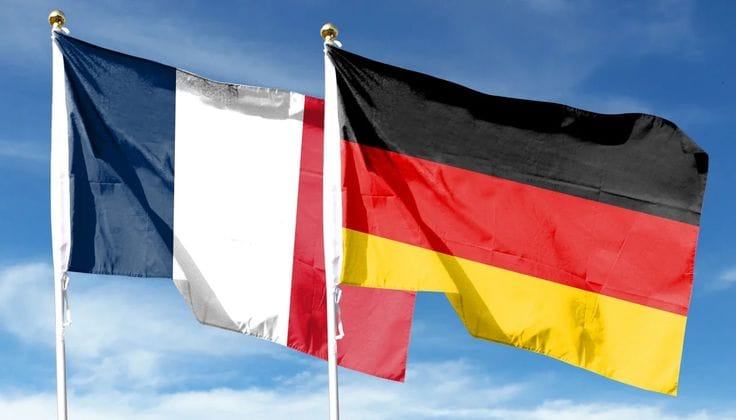
This article studies the political, structural and economic behaviour of two of the largest economies under the European Union, and highlights how a difference in perception of the problem, and adoption of adequate measures is vital for the growth and sustenance of economic health. Both France and Germany were limited by the same constraints; they had similar economic conditions at the dawn of the millennium, but within the very next decade, their economic trajectories diverged to such an extent that Germany went from being labelled as the ‘Sick Man of Europe’ to being the 3rd largest economy of the modern world, whereas France struggled to maintain its high per capita income, and has dropped down to the 7th rank by economic size.
Introduction: A Shared Challenge
Following the dotcom crash, the European Union was going through a sluggish phase, characterised by low growth rates, low productivity, higher costs, and, most importantly, high unemployment rates. Both economies were burdened with a plethora of complications: high unemployment, rigid labour laws, and a lack of competitiveness (which was leading to a loss of market share to Chinese and Eastern European manufacturing houses). Following China’s entry into the World Trade Organisation in 2001, global trade expanded rapidly. Between 2000 and 2008, world exports nearly tripled, intensifying both competition and opportunity.
Germany, especially, was facing severe economic problems. Following the union of Eastern and Western Germany in 1990, inefficiency had infiltrated the economy to a great extent. Unemployment was extremely high(11.2%), welfare spending was very heavy, the growth rate had slowed down, and labour costs were very high compared to the rest of the world, all of which led to a major lack of competitiveness on the global level.
A usual reaction to such an economic situation would be intentional devaluation of the country’s own currency, increasing global attraction for the country’s goods, and thus, eventually leading to an increase in exports. However, as members of the Eurozone, both Germany and France did not have this privilege available to them, as all control over their monetary policy was in the hands of the European Central Bank. This had one main implication: the solution had to emerge from internal reconstruction. Both countries had similar economic conditions, but their approach towards the problem was what made all the difference.
The Perception
Despite facing similar economic bottlenecks, the perception of economic urgency that this very situation required was a lot different for both countries.
Germany entered the 21st century with considerable economic strain. An average GDP growth rate of 1% across a period of 5 years (2001-2005) speaks volumes about the inefficiencies prevailing in the economy. With the economy still struggling to somehow make it back to its original grandeur, Germany was even named by many as the “Sick Man of Europe”. The crisis-like environment persisting in Germany made the government realise that major economic restructuring would be required to pull out of this mess.
France, on the other hand, had a somewhat better growth trajectory, averaging about 1.5% to 2.0% growth per annum for the same time period, with support from internal consumption. The state provided a welfare system to soften the social effects of unemployment and economic slump, which provided a measure of stability.
The difference in perceptions of crisis vs. manageable was significant. Germany proceeded with reform out of necessity, while France struggled with reform due to both political opposition and a lack of immediate need for action.
Germany’s Turning Point (2003-2005)
Germany’s economic turnaround began in 2003 under Chancellor Gerhard Schröder, with a series of major reforms in the labour market’s structure being made with a view to reducing and eventually removing the structural rigidities that had long hindered fuller employment of resources.
Famously known as the Hartz Reforms, these were introduced in phases from 2003 to 2005. Hartz I & II reforms had introduced “mini jobs” and “midi jobs”, which were a form of short-term recruitment options for organisations, with lower social security and tax burdens, and also a significantly reduced minimum period of employment. This spurred employment greatly and also resulted in lower costs per unit, since firms could hire more people and still spend less on social security schemes. The Federal Agency for Employment was reorganised by Hartz III; administrative changes helped improve the process of matching people to suitable jobs. Hartz IV was the most controversial of the Hartz reforms, as it combined unemployment benefits and welfare into one flat-rate benefit (Arbeitslosengeld II), decreased the length of time an individual may receive unemployment benefits (maximum 12 months for most individuals), and established stricter requirements for searching for available jobs. The results were nothing but soothing for Germany- atypical employment increased by a great margin, long-term unemployment declined(11.2% to 5.5% in 7 years), and employment increased by over 4 million.
France’s Caution and the Competitiveness Gap
France, on the other hand, maintained a more cautious approach, wherein the social security schemes, minimum wages, and minimum employment period still remained the same. The French played it safe- no immediate social impact, the public stayed happy, and so did the employees. But the impact it would have would prove to be devastating for France. Since the firms still had to pay for social security, and hiring was still a tedious job, the firms had to face higher costs of production compared to other countries in the EU. This limited job creation to a great extent and also increased unemployment. Also, it gradually resulted in a decrease in the competitiveness of France in the global market.
Evidence of divergence emerged from an examination of the dynamics of wages.
Diverging Growth Models, Globalisation, and Crisis
Germany’s resilience was rewarded by the global market in the years to come. In 2007, Germany became one of the world’s highest exporters, having a total of 969 billion dollars in exports, at an 8.5% increase from 2006. France, by contrast, relied more on domestic demand, with weaker exports contributing to a trade deficit of 2-3% by 2010. In Germany, wage growth had lagged the growth in productivity, resulting in declining unit labour costs over a sustained period. By 2008, German costs were approximately 20% lower, relative to their Eurozone partners, than they were in the late 1990s. In contrast, French wages have increased at least as fast, if not faster than, the rate of productivity increase. Thus, the costs in France increased, and this eroded its ability to export competitively. This phenomenon, more commonly known as “internal devaluation,” allowed Germany to regain its competitiveness without adjusting its currency, while France’s position gradually deteriorated.
After building on its existing economy, China’s accession to the WTO widened this gap by boosting German exports and increasing competitive pressures on France. The Global Financial Crisis was devastating within Europe for some member states, while others were largely unaffected, creating an economic divide: Germany rebounded from a 5% contraction at a very fast rate; France suffered through a slower recovery and continued higher volumes of unemployment, thereby establishing long-term structural differences between member countries.
Conclusion
The economic gap between Germany and France reveals a stark contrast in how these countries have handled economic adjustments. Germany’s approach has been to accept the pain of short-term disruption in order to regain its competitiveness in the market, while France has opted for stability (both economic and political), which has resulted in maintaining their social cohesion but delaying any needed structural changes to their economy. While it may seem that stability is more beneficial in the short term, eventually, without an adjustment being made to their economies, growth will stop, inefficiencies will creep into the system, and France’s economy will suffer over the long-term. The experience of Germany and France illustrates a broader theme regarding reform versus status quo: Change, though uncomfortable initially, is inevitable in the long run.
References:
- Organisation for Economic Co-operation and Development. (n.d.). Employment rate [Data set]. OECD Data Explorer. https://www.oecd.org/en/data/indicators/employment-rate.html
- Database.earth. (n.d.). Germany GDP growth rate. https://database.earth/economy/germany/gdp-growth-rate
- World Bank. (n.d.). Unemployment, total (% of total labor force) (modeled ILO estimate) – Germany, France [Data set]. World Bank Open Data. https://data.worldbank.org/indicator/SL.UEM.TOTL.ZS?locations=DE-FRV
- Woodcock, S. D. (2020). The effect of the Hartz labor market reforms on post-unemployment wages, sorting, and matching (IZA Discussion Paper No. 13300). Institute of Labor Economics (IZA). https://www.iza.org/publications/dp/13300/the-effect-of-the-hartz-labor-market-reforms-on-post-unemployment-wages-sorting-and-matching
- World Bank. (2007). Country profile: World – exports and imports by partner country, 2007 [Data set]. World Integrated Trade Solution (WITS). https://wits.worldbank.org/CountryProfile/en/Country/WLD/Year/2007/TradeFlow/EXPIMP/Partner/by-country
- World Bank. (n.d.). GDP growth (annual %) – Germany, France [Data set]. World Bank Open Data. https://data.worldbank.org/indicator/NY.GDP.MKTP.KD.ZG?locations=DE-FR
- Organisation for Economic Co-operation and Development. (n.d.). Trade in goods and services [Data set]. OECD Data Explorer. https://www.oecd.org/en/data/indicators/trade-in-goods-and-services.html