
Every option we keep “just in case” comes with a price, even when we don’t notice paying it. This piece explains why that safety net may be costing you more than you think, from the waitlisted train tickets that earned Indian Railways crores to dating apps that charge you to keep swiping. It’s about the hidden price of keeping your options open, and why the best returns come from finally committing.
“Better safe than sorry” is a saying that almost all of us have heard, and probably used, too. We were taught to be careful, to think logically, and to always have a backup. The more options we have, the safer we feel. Just a few months ago, many of us were busy compiling our lists of college choices. We researched and asked seniors for advice on what our top choice should be, but then we kept adding names further down, not because we actually wanted to go there, but because we wanted something to fall back on if our first choice failed us. But what if the habit goes on long after its utility, and we’re so worried about leaving options open that we find it hard to stick to the one choice we really wanted?
Why We Keep Doors We Never Enter
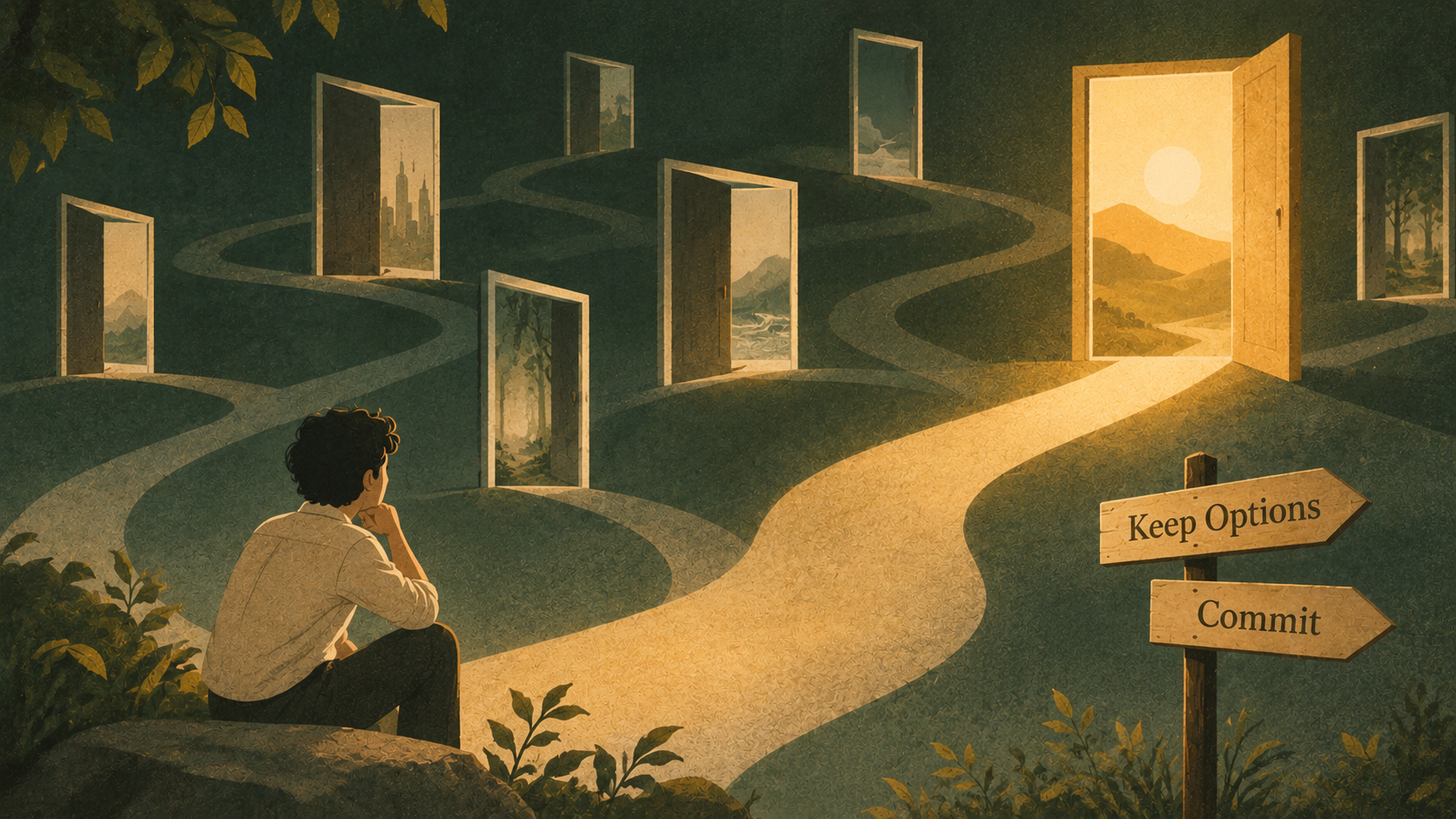
We know options are good at the beginning; they give a certain degree of flexibility and freedom. But after a point, they become counterproductive. We keep them around for a variety of reasons: fear of a better option (FOBO) keeps us wondering whether something more suitable might appear just after we commit. Sometimes, we keep options simply for reassurance: even if we never use them, knowing they exist makes us feel more in control. Risk aversion adds to this, as relying on a single path can feel more threatening than maintaining several alternatives.
Sometimes, an option becomes harder to surrender simply because it is about to disappear. In 2004, Jiwoong Shin and Dan Ariely built a game with three doors, each leading to a room where clicks earned money. Any door a player ignored began to shrink and would eventually vanish. Players kept spending clicks to rescue the fading doors, even when those rooms paid no better, and walked away with less money. Due to loss aversion, open options are seen as assets we already own, and closing one feels like booking a loss.
Options Are Good, Until They Aren’t
In finance, an option is a right, not an obligation. It has a premium, which is the price of holding it, and an expiry date. Its payoff arrives only if you exercise it. In a way, all the backups we keep are also options, because we pay to keep them, they don’t last forever, and they are only worth something if we actually end up using them.
Psychologist Barry Schwartz, author of ‘The Paradox of Choice’, points out that, logically, an extra option shouldn’t make us worse off, since we can always ignore it. Yet the more options there are, the more likely we are to pick one that is not the ‘best one’, and that possibility makes us dissatisfied with whatever we choose.
Consider something as ordinary as buying jam. In a study published in 2000, Sheena Iyengar and Mark Lepper compared shoppers’ responses to displays offering six or twenty-four varieties. Shoppers were more likely to buy from the smaller selection. A wider variety prompted people to explore, but did not lead them to make any conclusive decision. More options did not lead to better choices; they led to fewer choices.
The distinction matters: discovering alternatives and choosing between them are different things. Early in a decision, another option may reveal something useful about our preferences. Later, it may simply add another comparison.
The presence of various options also confuses us. The option to back out gives us less happiness, because in our head we will always want to go down the route that could have been, and that comparison will always lead to unhappiness with what we have.
Psychologists Daniel Gilbert and Jane Ebert showed this with photography students, who each kept one of two prints they had made. The students who were allowed to swap later liked their print less, yet most people said they would prefer the deal that let them swap their print for the other one. The freedom they expected to appreciate was exactly what made it harder to be happy with their decision.
The comparison may stay even when there are no options, but then we know the other situation was just imaginary. If we did have that option and chose not to exercise it, we feel horrible. There will always be some contingency that could have changed the whole scenario, so there is no such thing as the best choice; there are only marginal benefits and marginal costs.
And this doesn’t just stay in our heads; it shows up in the work we do as well. First, dividing our attention between several options can reduce the quality of the work we put into any one of them. Secondly, knowing that an alternative is available can subconsciously lead one to work less hard. The very options we kept to protect ourselves from failure can then limit the effort needed to succeed.
How Flexibility Is Priced and Sold
Real Options Theory tells us that flexibility is worth paying for when the future is very uncertain and too many variables make a concrete decision impossible. Flexibility does have genuine value. That genuine value is exactly what sellers can overcharge for, and businesses have built entire pricing schemes appealing to this risk-averse side of us. When we book train tickets and are not completely sure the date will work out, the option to cancel provides us great relief. But this option to back out is exactly what allows sellers to charge a premium. This premium is worthless to us when our plans are certain, but we often end up paying it ‘just in case’, even when we are unlikely to ever use it.
Every festive season, families across India book waitlisted train tickets “just in case”, sometimes on two or three trains for the same journey. When a waitlisted ticket is cancelled, the clerkage charge and convenience fee are not refunded, and the Railways reported earning about ₹1,230 crore from such cancellations between 2021 and 2024. Between 2017 and 2020, more than 9.5 crore passengers never cancelled their waitlisted tickets, which brought in over ₹4,335 crore. The Ministry’s reason for waitlists is a fair one: they stop seats from going empty when confirmed passengers cancel. The flexibility is real, which is exactly why it can be charged for. “Better safe than sorry” begins to sound a little different when we realise that someone gets to put a price on “safe”.
And thus, once flexibility becomes something we can buy, a different question emerges: “How much of the price reflects useful protection, and how much reflects our reluctance to commit?”
Let’s take up the example of Hinge, which has a famous tagline: “Designed to be deleted.” It’s odd to say that about a business model designed to earn money every month you don’t delete it. The match you never text but never unmatch is one of those doors. Paid tiers go a step further and sell the options themselves: more swipes, a “boost” to put your profile in front of more people, and a list of who has already liked you. In other words, you pay to make your pool of choices even wider, even though a larger pool makes you less likely to choose at all. This keeps the users hooked. Dating apps are the clearest version of a question most of us never ask: when we pay to keep our options open, what are we actually buying?
The seller is not only the app, but it is also our own mind, which treats every open option as something worth guarding.
Giving “Just in Case” an Expiry Date
In 207 BC, at the Battle of Julu, General Xiang Yu ordered his soldiers to sink their boats and smash their cooking pots, leaving three days’ worth of rations. With retreat no longer an option, his outnumbered army won. The Chinese idiom ‘pò fǔ chén zhōu’, “break the cauldrons and sink the boats”, still means committing with no way back.
Xiang Yu destroyed his backup, but today we pay a monthly fee to keep ours. An option that is never exercised yields nothing; committing is the only way to yield any return.
But this doesn’t mean we all should become General Xiang; we do not have to close every door to move forward. We can begin by giving each open option a purpose. What risk does it protect us against? What new information are we waiting for? What will it cost to keep it available? A useful option should have answers to these questions and a deadline.
For everyday decisions, this might mean setting a research deadline, shortlisting a few meaningful choices, or striking away an option that no longer serves a purpose. For bigger decisions, keeping a safety net is sensible. However, once we choose, we should give the chosen option a fair period of effort rather than returning to our previous options again and again.
There is something reassuring about this: a decision does not have to be perfect to be worthwhile. Its value grows with the care and work we put into it. Choosing a single option closes some possibilities, but it also makes others possible: the skills developed by staying with a course, the confidence built through practice, the progress that comes from sustained focus.
Keeping a door open gives us somewhere we could go. At some point, we deserve to see what happens when we walk through it.
References:
- Tierney, J. (2017, July 3). Dear irrational reader: Close the door! TierneyLab. https://archive.nytimes.com/tierneylab.blogs.nytimes.com/2008/02/25/dear-irrational-reader-close-the-door/
- Scheibehenne, B., & Todd, R. G. a. P. M. (2010). Can there ever be too many options? A Meta‐Analytic Review of choice Overload. Journal of Consumer Research, 37(3), 409–425. https://doi.org/10.1086/651235https://www.jstor.org/stable/10.1086/651235
- PTI, & PTI. (2020, February 25). Railways earned Rs 9,000-cr from ticket cancellation charges, non-cancellation of wait-listed tickets. Deccan Herald. https://www.deccanherald.com/amp/story/business/railways-earned-rs-9000-cr-from-ticket-cancellation-charges-non-cancellation-of-wait-listed-tickets-808001.html
- Bloom, S. (n.d.). The eject button mentality | The Curiosity Chronicle. Sahil Bloom. https://www.sahilbloom.com/newsletter/the-eject-button-mentality
- Mukherjee, V. (2024, March 20). Indian Railways earned Rs 1,229 cr from cancelled waiting list tickets. www.business-standard.com. https://www.business-standard.com/amp/india-news/indian-railways-earned-rs-1-229-cr-from-cancelled-waiting-list-tickets-124032000421_1.html?utm_source=chatgpt.com