

The Gym Card in Your Wallet
Somewhere in a drawer, or perhaps still in your wallet, there is probably a membership you meant to cancel. Stefano DellaVigna and Ulrike Malmendier (2006) went looking for people like you in three American health clubs, and what they found should embarrass all of us a little. Members who signed up for a flat fee of over $70 a month went to the gym 4.8 times a month on average. That came to more than $17 a visit, at clubs where anyone could walk in and pay $10. Over the course of their memberships, these people left roughly $700 on the table.
The number that stayed with me, though, is a smaller one. After their final workout, members waited an average of 2.29 months before cancelling, and paid about $185 for that stretch of not going. I doubt a single one of them sat down and decided this was money well spent. They kept meaning to cancel, and kept not doing it.
Economists have names for both halves of this. Samuelson and Zeckhauser (1988) called our habit of sticking with whatever is already in place status quo bias. O’Donoghue and Rabin (1999) showed how people who give the present a little too much weight can put off a task they fully intend to do almost indefinitely, because tomorrow always looks like a better day for it. Put the two together, and you get the gym card in the drawer, the subscription that renews every March, and the SIM plan nobody has looked at since the day it was activated. Since 2023, even Indian income tax has come with a box already ticked, with the new tax regime applying to anyone who does not opt out (Sitharaman, 2023).
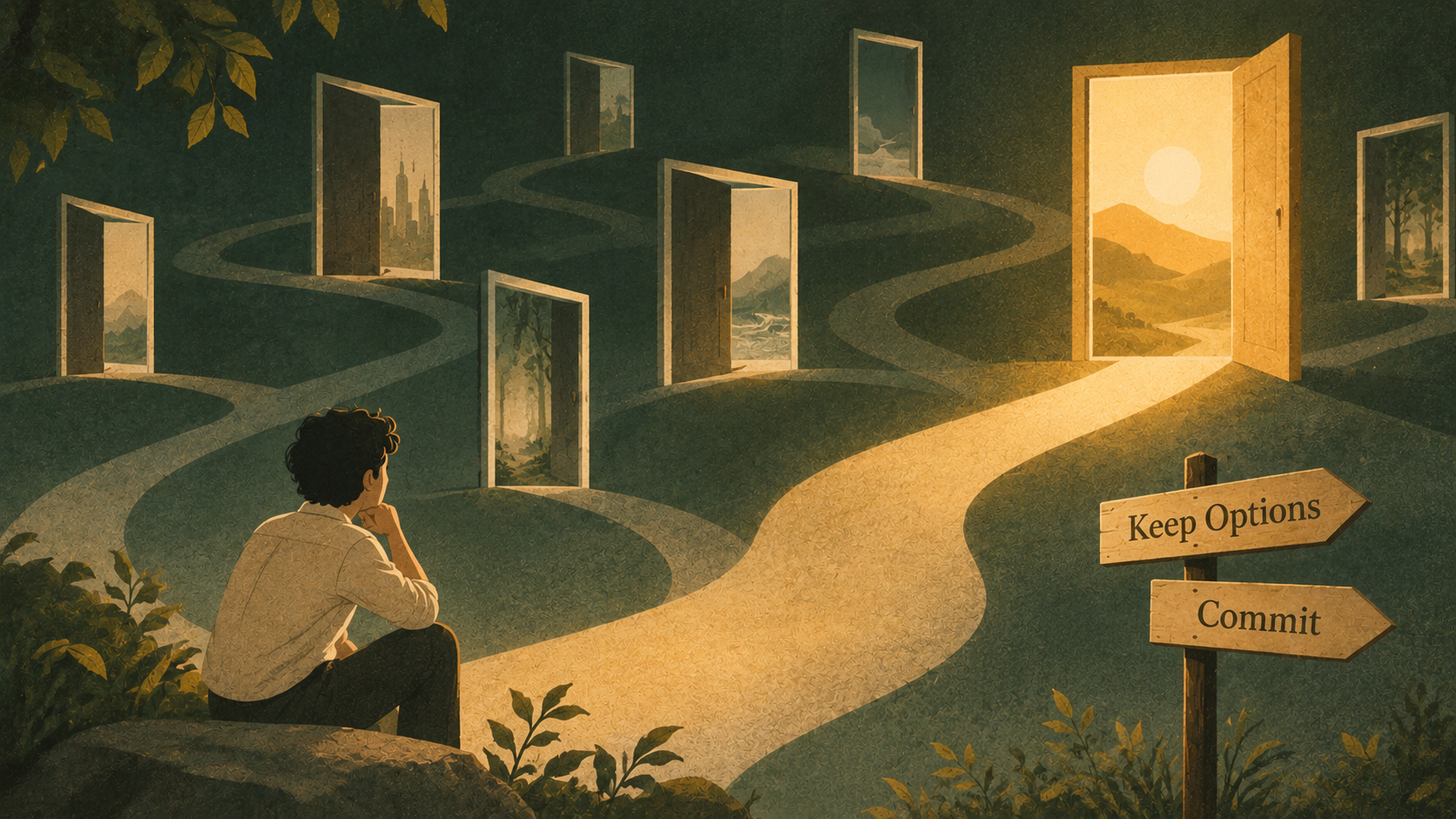
My argument is that leaving a default alone always costs something, even when no bill arrives to say so. And because so much of economic life now comes pre-selected, what people end up with often tells us less about what they wanted than about how hard it was to leave.
Two Neighbours and a Form
The obvious reply is that people stick with defaults because defaults tend to be sensible, and perhaps the gym members were simply wild optimists. Testing that properly would need two groups of people who are alike in nearly every way, apart from the box that was ticked for them.
Germany and Austria come remarkably close. They share a language, a good deal of history, and a long border. Yet when Johnson and Goldstein (2003) compared organ donor consent across Europe, only 12% of Germans had agreed to donate, against 99.98% of Austrians. Nobody seriously believes Austrians are eight times kinder than Germans. What differed was the form. Germans had to opt in, while Austrians were counted as donors unless they opted out.
Madrian and Shea (2001) saw the same thing inside a single American company that switched its retirement savings plan to automatic enrolment and changed nothing else. The pay, the employer’s contribution, and the investment options all stayed as they were, yet participation among new hires leapt from 37% to 86%. What I find strangest is what the new savers did next, which was almost nothing. Of those enrolled automatically, 71% stayed at the default contribution of 3% of pay, in the default fund, a low-return money market account few would have picked on purpose. A cautious placeholder chosen by the company had become the retirement plan of thousands of people.
There is a twist, and it takes us back to Austria. All those ticked boxes did not produce anything like an equivalent lead in actual donors. Once Abadie and Gay (2006) controlled for other differences between countries, presumed consent was linked to donation rates roughly 25% to 30% higher. That is a real gain, though a far cry from what the consent figures promise, partly because families are often still asked before any organ is taken. On paper, Austria looked almost unanimous; however, at the bedside, people were still deciding.
A default, then, can manufacture something that looks very much like a preference without anyone having formed one. Using Danish records, Chetty et al. (2014) estimate that around 85% of people are passive savers, who barely respond to incentives that ask them to act, yet go along with whatever is arranged for them automatically. For most of us, I suspect, the ticked box ends up standing in for an opinion we never got round to having.
Who Benefits from Inaction
If our inertia is this dependable, someone is bound to notice. Thaler and Sunstein (2008) call whoever designs the setting of a decision a choice architect, and the question worth asking is which way the architect would like us to drift.
In 2016, Britain’s Competition and Markets Authority finished a two-year investigation into the energy market. It found that 70% of households supplied by the six biggest energy companies were sitting on default “standard variable” tariffs. Each could have saved more than £300 by switching, and together they were paying around £1.4 billion a year more than they would have in a properly competitive market (Competition and Markets Authority [CMA], 2016). Of course, nobody had cheated these households in any dramatic sense. They had just never got round to ringing up, and the companies had little reason to remind them.
Now, set that beside the pension plan, and the contrast is striking. In one case, the people who did nothing ended up with savings their employer hoped they would want. In the other, the people who did nothing paid for the profits of firms whose best customers were the ones who never compared prices. Subscriptions sit firmly in the second camp. Starting a free trial takes a tap, while leaving often means hunting through settings for a button someone has taken care to hide. Surely, nobody needs to be lied to. It is enough that cancelling is always slightly more of a bother than staying.
And this very problem has also drawn the attention of regulators in India. In June 2025, the Central Consumer Protection Authority asked e-commerce platforms to audit their interfaces for dark patterns, including but not limited to subscription traps, and to take steps to eliminate deceptive design practices (Ministry of Consumer Affairs, Food & Public Distribution, 2025). Once again, the concern is not simply that consumers forget to cancel. It is that the digital environment in which they make decisions can be designed to make staying easier than leaving. What may look like an individual’s failure to act may, in part, be a consequence of how the choice itself has been arranged.
The Price of Saying No
I don’t think the answer is to distrust every default. Deciding things is tiring, and a world in which every phone setting, insurance plan, and tax form had to be chosen from scratch would wear us out long before it made us any freer.
What I do think is that we should stop treating inaction as if it were free. Every default comes with a price for saying no, paid in time, in information, and in the small amount of nerve it takes to change something. When that price is low, and the default serves the person who accepts it, defaults are one of the kindest ideas economics has produced. When it is high, and the gains flow to whoever set it, accepting the default starts to look a lot like paying a fee for not paying attention.
So the next time you notice a box already ticked, it may be worth asking what it would cost you to untick it, and who benefits if you never do. Most of us make far more choices this way than we would care to admit. We rarely notice, because the bill always arrives ever so politely.
References
- Abadie, A., & Gay, S. (2006). The impact of presumed consent legislation on cadaveric organ donation: A cross-country study. Journal of Health Economics, 25(4), 599–620. https://doi.org/10.1016/j.jhealeco.2006.01.003
- Chetty, R., Friedman, J. N., Leth-Petersen, S., Nielsen, T. H., & Olsen, T. (2014). Active vs. passive decisions and crowd-out in retirement savings accounts: Evidence from Denmark. The Quarterly Journal of Economics, 129(3), 1141–1219. https://doi.org/10.1093/qje/qju013
- Competition and Markets Authority. (2016, June 24). CMA publishes final energy market reforms [Press release]. GOV.UK. https://www.gov.uk/government/news/cma-publishes-final-energy-market-reforms
- DellaVigna, S., & Malmendier, U. (2006). Paying not to go to the gym. American Economic Review, 96(3), 694–719. https://doi.org/10.1257/aer.96.3.694
- Johnson, E. J., & Goldstein, D. G. (2003). Do defaults save lives? Science, 302(5649), 1338–1339. https://doi.org/10.1126/science.1091721
- Madrian, B. C., & Shea, D. F. (2001). The power of suggestion: Inertia in 401(k) participation and savings behaviour. The Quarterly Journal of Economics, 116(4), 1149–1187. https://doi.org/10.1162/003355301753265543
- O’Donoghue, T., & Rabin, M. (1999). Doing it now or later. American Economic Review, 89(1), 103–124. https://doi.org/10.1257/aer.89.1.103
- Samuelson, W., & Zeckhauser, R. (1988). Status quo bias in decision making. Journal of Risk and Uncertainty, 1(1), 7–59. https://doi.org/10.1007/BF00055564
- Sitharaman, N. (2023, February 1). Budget 2023–2024: Speech of Nirmala Sitharaman, Minister of Finance [Speech transcript]. Ministry of Finance, Government of India. https://www.indiabudget.gov.in/budget2023-24/doc/budget_speech.pdf
- Thaler, R. H., & Sunstein, C. R. (2008). Nudge: Improving decisions about health, wealth, and happiness. Yale University Press.
- Ministry of Consumer Affairs, Food & Public Distribution. (2025, June 7). Central Consumer Protection Authority issues advisory to E-Commerce Platforms for self-audit within 3 months to detect Dark Patterns and ensure its resolution [Press release]. Press Information Bureau. https://www.pib.gov.in/PressReleaseIframePage.aspx?PRID=2134765&lang=2®=48