
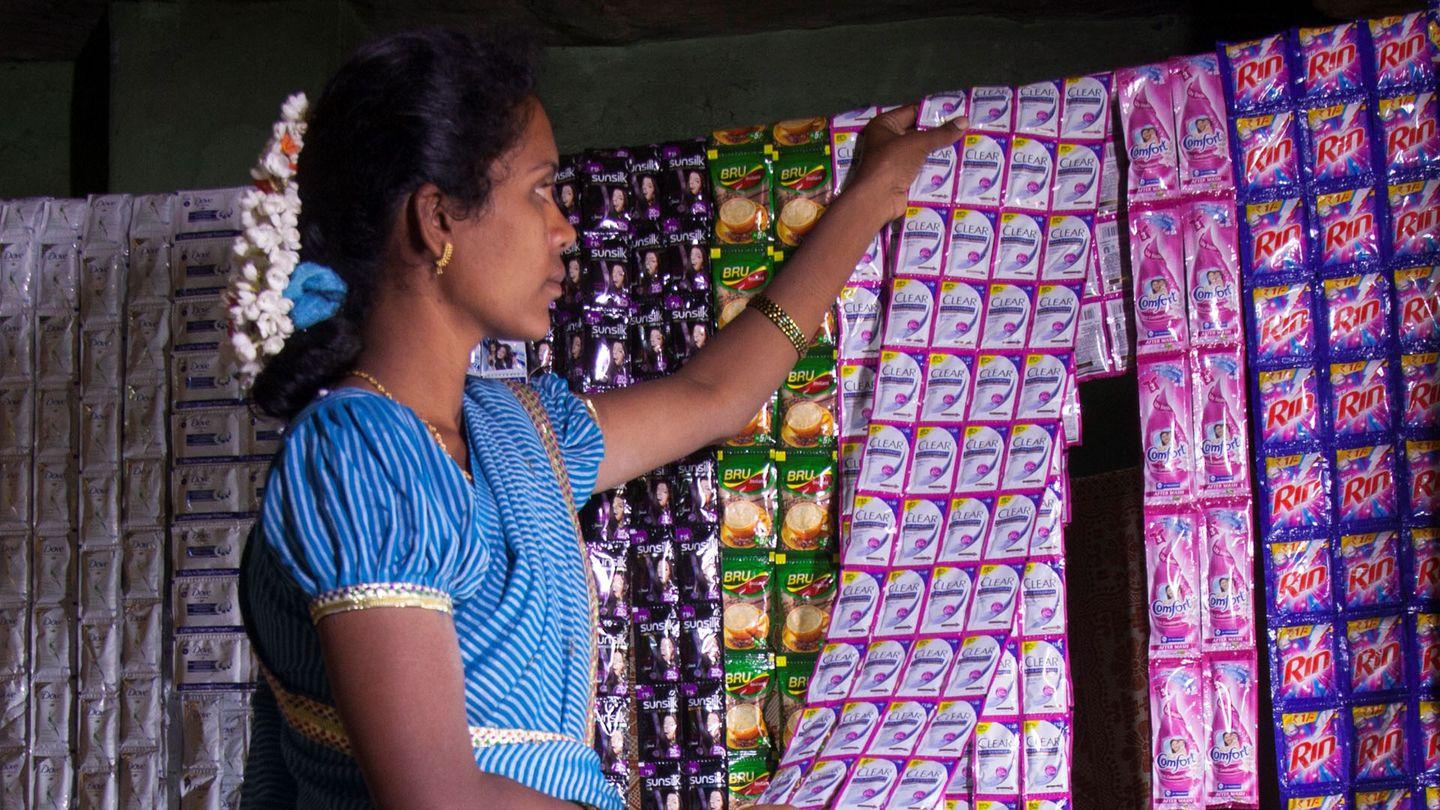

What is the price of not having ₹150? At the local kirana store, the answer may come in a ₹5 packet. A larger bottle or a refill pack might offer better value, but that saving is meaningless to someone who cannot afford the upfront price. For a household with irregular earnings, purchasing shampoo, detergent or coffee in small quantities is not necessarily poor financial planning; it may just be the only available choice they have.
This is the central paradox of India’s micropack economy. Low-priced packets bring branded products within reach, but their small size and quantity are often assumed to make consumers pay more per gram or millilitre. If people with the least cash or irregular earnings repeatedly pay the highest unit price, then micropacks create a “poverty premium”. But if companies deliberately price the micropacks cheaply to attract price-sensitive consumers, they may instead democratise consumption.
Which description is correct? The answer is less convenient and more interesting than either side suggests.
Affordability Is Not the Same as Cheapness
A consumer who chooses a ₹5 packet over a ₹150 bottle is not necessarily irrational, as this decision may reflect a liquidity constraint. Although a larger packet may offer better long-term value, a cash-constrained buyer may not be able to meet its upfront cost. Uncertain incomes, limited savings, little storage space and the need to avoid wastage can all make a smaller packet the rational choice.
This clearly differs from a behavioural explanation. A ₹5 price may act as a psychological anchor, while mental accounting may make several small purchases feel less expensive than one visible expense. Present bias may also cause an immediate saving in cash expenditure to take precedence over higher future expenses.
However, even this comparison requires caution. It would be misleading to multiply the price of one sachet by thirty unless a consumer actually purchases and uses one every day. A pre-portioned sachet may help control consumption or reduce wastage. The same purchasing pattern can, therefore, arise from two different mechanisms: genuine financial constraint or the reduced visibility of cumulative expenditure. Policy must distinguish between them.
Does the Unit-Price Penalty Actually Exist?
A poverty premium cannot be established unless three conditions are satisfied. The products being compared must be the same product and variant; the micropack must be more expensive per unit; and the consumer’s inability to afford the larger pack should be the reason why the person pays more.
Let’s consider a snapshot of maximum retail prices for three same-brand comparisons available online on 29 September 2026:
| Product comparison | Micropack MRP | Larger-pack MRP | Micropack unit price | Larger-pack unit price | Difference |
|---|---|---|---|---|---|
| Clinic Plus Strong & Long: 6 ml sachet vs 355 ml bottle (BigBasket, 2026a; LOTS Wholesale Solutions, 2026) | ₹1 | ₹249 | ₹16.67/100 ml | ₹70.14/100 ml | Micropack 76.2% cheaper |
| Surf Excel Quick Wash: 60 g pouch vs 4 kg pack (BigBasket, 2026d) | ₹10 | ₹750 | ₹16.67/100 g | ₹18.75/100 g | Micropack 11.1% cheaper |
| Nescafé Classic: 2.2 g sachet vs 45 g pack (BigBasket, 2026b, 2026c) | ₹5 per sachet | ₹230 | ₹227.27/100 g | ₹511.11/100 g | Micropack 55.5% cheaper |
Note. Maximum retail prices were recorded from the cited online product pages on 29 September 2026. The ₹5 Nescafé sachet price is calculated from a ₹150 pack containing 30 sachets of 2.2 g each (BigBasket, 2026c). Online prices and product availability may vary by location and change over time.
This small comparison is, of course, not reflective of all brands, all retailers, and all categories of products. Pack sizes and promotional prices could vary. Local kirana pack prices could differ from the online pack prices. The comparison shows an important fact: the micropack is not necessarily higher-priced per unit of weight or volume. In all three cases above, it is cheaper.
It is not a new observation. A study of sachet marketing in India found that P&G shampoo sachets priced per millilitre were about 55% of the bottle prices. The authors related this fact to low-cost flexible packaging, high sales volumes, and good distribution systems (Singh et al., 2009). However, the study is 17 years old and predates current packaging technologies, distribution systems, and pricing strategies. These findings should, therefore, serve as historical context rather than direct evidence of present-day cost structures.
Micropacks can, therefore, turn the regular quantity discount upside down. A company may price a micropack aggressively to protect a popular ₹1, ₹5 or ₹10 price point, induce product trials, gain market share or convert consumers from unbranded competitors. In all such cases, the micropack could be affordable right away.
Cost Recovery or Extracted Margin?
Suppose another product does carry a positive micropack premium. Comparing prices would reveal the gap, but not its cause. Smaller packs may require more packaging material relative to the amount of product sold, more individual filling and sealing, greater handling, and higher retailer commissions per gram. Conversely, a lightweight sachet may be substantially cheaper to manufacture and transport than a rigid bottle. Promotions can further distort the comparison because larger packs are often discounted online while low-priced packets remain at maximum retail price.
Distinguishing between cost recovery and margin extraction would, therefore, require product-specific information about the cost of packaging, manufacturing, distribution and trade margins, which companies rarely disclose in their publicly available financial statements. In the absence of such information, the gap should be described as an observed or unexplained premium, rather than as an exploitative practice.
The price premium does not necessarily amount to traditional price discrimination either. The packet and bottle are associated with different cost structures and convenience value. “Nonlinear” or quantity-based pricing is the more accurate starting point. It becomes a possible form of second-degree price discrimination only if companies deliberately design the menu of pack sizes to sort consumers according to their willingness or ability to pay.
The honest conclusion is that unit-price data can test whether a premium exists, but it cannot independently prove the reason for its existence. A large premium that persists across all retailers and greatly exceeds the packaging and handling costs would support the case for the margin-capture hypothesis, but it would still not prove it.
The Premium That Does Not Appear on the Receipt
Even when micropacks reduce consumers’ spending, there is still an environmental price to pay for this. Many packets and small pouches are made from multiple layers of plastic, aluminium, or other materials in order to preserve their contents. These fused multiple layers make their separation and subsequent recycling very tough. Additionally, their small size and low resale value also make them unattractive to waste collectors. Research on multilayer packaging in India cites these characteristics as major barriers to recycling (Gireesh & Satwik, 2024).
The result is an externality: the retail price does not incorporate the full cost of collecting, sorting and recycling the discarded packet. That cost is transferred to municipalities, waste workers and communities affected by dumping or burning.
India’s Plastic Waste Management framework places the primary responsibility for collecting used multilayered sachets, pouches and packaging on producers, importers and brand owners. Extended Producer Responsibility rules and guidelines on plastic packaging are also issued by the Central Pollution Control Board (2022). The central question is, therefore, no longer whether producers have responsibility in principle, but whether the responsibility creates a strong enough motive or incentive to replace packaging that cannot be recycled.
Preserving Access Without Preserving Waste
A complete ban on micropacks would be a rather blunt move that may also be potentially regressive, as it could remove the only affordable purchasing option that is available to some consumers while leaving the underlying income constraint unaddressed. A better policy would preserve low cash outlays while improving transparency and transferring the burden of waste management to producers.
Consumers should be able to compare sizes of the packages easily. India’s Legal Metrology rules stipulate that unit sale prices are to be declared for most packaged products, but packs with a maximum retail price of ₹35 or less or very small display areas receive an exemption (Department of Consumer Affairs, 2022). It is the exact goods that need such comparisons that fall in these exemptions. Standardised shelf and online labels showing the price per 100 grams or 100 millilitres could close this gap without restricting choice.
Producer-responsibility charges should take into account recyclability and collection difficulty, rather than just the small weight of each packet. This will incentivise firms to invest in recyclable mono-material packaging and finance collection through kirana stores.
Also, refill schemes deserve carefully designed trials. Secure dispensers for products like shampoo and detergents could allow consumers to buy ₹5 or ₹10 worth at a time in reusable bottles. Such schemes must address hygiene, measurement and retailer costs, but they do show that affordability does not necessarily mean disposable packaging.
The ₹5 micropack is, therefore, neither a straightforward success story nor a universal poverty trap. The price evidence shows that small packets can increase access without costing more per unit. The real problem is that their environmental costs are hidden from view and remain largely invisible.
The fairest measure is not whether a packet is small, but whether consumers can see its true unit price, obtain an equally affordable low-waste, similarly-priced alternative and return its packaging through a system financed by the producer. Until such a point is reached, ₹5 may democratise consumption at the expense of socialising the cost of what gets thrown away.
References
BigBasket. (2026a). Clinic Plus strong & long milk protein & multivitamin shampoo, 355 ml. Retrieved September 29, 2026, from https://www.bigbasket.com/pd/100081530/clinic-plus-strong-long-health-shampoo-340-ml/
BigBasket. (2026b). Nescafé Classic instant coffee powder, 45 g. Retrieved September 29, 2026, from https://www.bigbasket.com/pd/267400/nescafe-classic-100-pure-instant-coffee-50-g-pouch/
BigBasket. (2026c). Nescafé Classic instant coffee powder, 66 g (30 × 2.2 g). Retrieved September 29, 2026, from https://www.bigbasket.com/pd/40362937/nescafe-classic-instant-coffee-66-g/
BigBasket. (2026d). Surf Excel Quick Wash detergent powder. Retrieved September 29, 2026, from https://www.bigbasket.com/pd/40019098/surf-excel-quick-wash-detergent-powder-60-g-pouch/
Central Pollution Control Board. (2022). Plastic waste management rules and guidelines on extended producer responsibility for plastic packaging. Government of India. https://cpcb.nic.in/rules-4/
Department of Consumer Affairs. (2022, April 6). Frequently asked questions regarding declaration of unit sale price under the Legal Metrology (Packaged Commodities) Amendment Rules, 2022. Food Safety Works. https://foodsafetyworks.com/news/legal-metrology-faqs-on-unit-sale-price-declaration-in-packaged-commodities/
Gireesh, G., & Satwik, B. N. (2024, February 8). Plastic waste management in India with special emphasis on multilayered packaging. Centre for Environmental Law Education, Research and Advocacy, National Law School of India University. https://ceerapub.nls.ac.in/plastic-waste-management-in-india-with-special-emphasis-on-multilayered-packaging/
LOTS Wholesale Solutions. (2026). Clinic Plus strong and long shampoo sachet, 6 ml (pack of 96). Retrieved September 29, 2026, from https://www.lotswholesale.com/product/clinic-plus-strong-and-long-shampoo-sachet-6-ml-pk96
Singh, R., Ang, R. P., & Sy-Changco, J. A. (2009). Buying less, more often: An evaluation of sachet marketing strategy in an emerging market. The Marketing Review, 9(1), 3–17. https://doi.org/10.1362/146934709X414297